The short answer, by situation
| Your situation | Buy this |
|---|---|
| Wall box with a socket, or public posts, and a car built after 2018 | Type 2 to Type 2, 7.4kW, 5m |
| Car charges at 11kW or 22kW on AC, and you use public posts | Type 2 to Type 2, 22kW, 5m. Full speed on three phase posts, and it still works on a 7kW post. |
| Car has a Type 1 socket (5 pins) | Type 1 to Type 2, 7.4kW. Type 1 is single phase only, so there is no faster version. |
| No charger at home, only a normal 3-pin socket | A portable charger, often called a granny charger |
| You want to run a kettle, tools or camping kit from the car | A V2L (vehicle to load) cable, if your car supports it |
| You only use rapid chargers | Nothing. Every rapid charger has its own cable fixed on. |
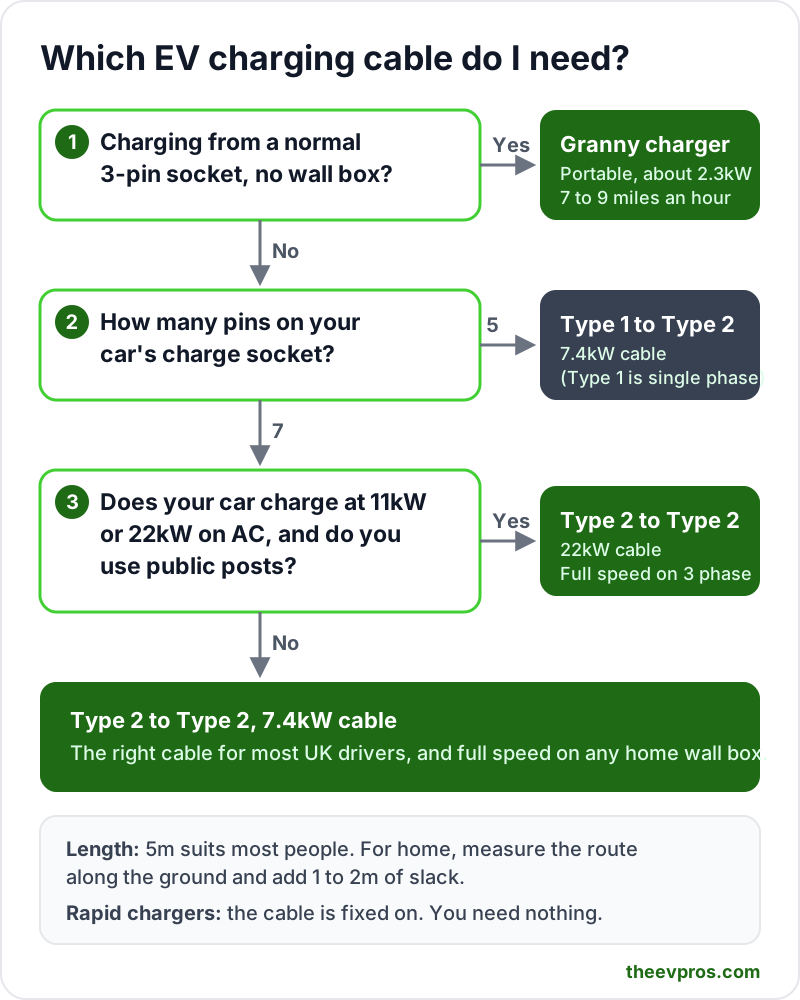
If you would rather answer three questions online and be told, our cable finder picks the cable, rating and length for your car.
Step 1: check which socket your car has
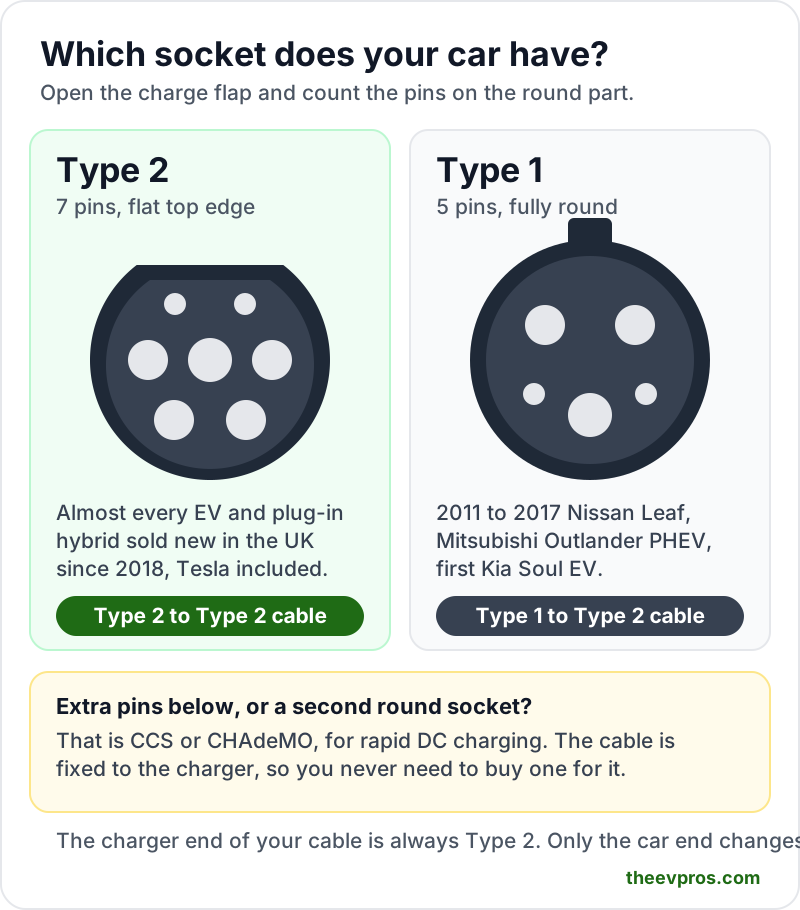
Open the charge flap and count the pins on the top, round part of the socket.
- Type 2: seven pins with a flat edge across the top. This is the European standard and it is on almost every EV and plug-in hybrid sold new in the UK since 2018, Tesla included.
- Type 1: five pins in a fully round housing. Found on older Japanese and American designed cars: the 2011 to 2017 Nissan Leaf, the Mitsubishi Outlander PHEV, the first generation Kia Soul EV and a handful of early plug-in hybrids.
Below the round part, many cars have two large extra pins (CCS) or a separate round socket (CHAdeMO). Those are for rapid DC charging and have nothing to do with the cable you buy, because every rapid charger has its own cable fixed to it.
Almost every UK public AC post and untethered wall box has a Type 2 socket. So the charger end of your cable is always Type 2. Only the car end changes.
Step 2: check how fast your car charges on AC
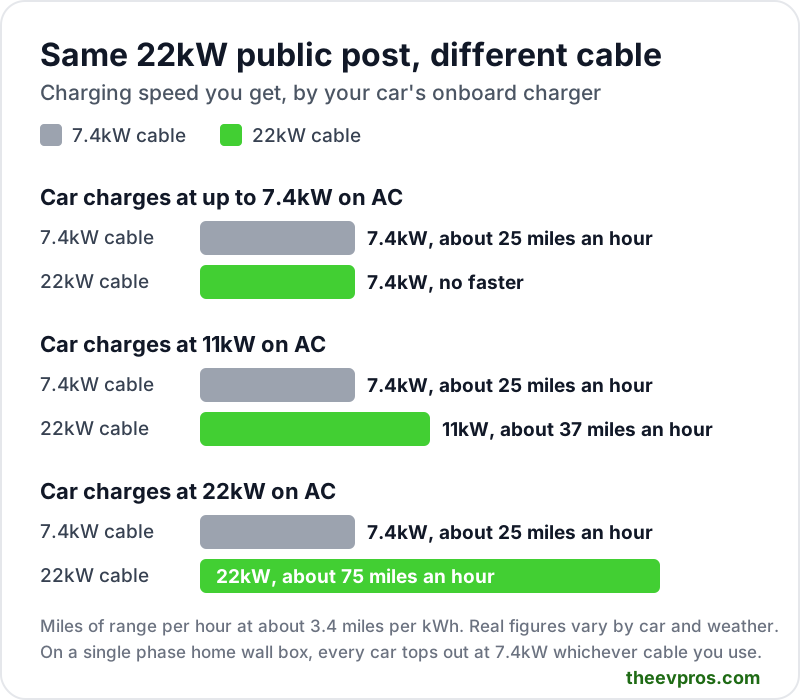
Your car has an onboard charger that sets its maximum AC charging speed. The charge you get is the lowest of three numbers: the post, the cable and the car. A bigger cable cannot make a car charge faster than its onboard charger allows.
- Up to 7.4kW (for example 6.6kW or 7.2kW): most older EVs, the Nissan Leaf 40kWh and e+, the MG4 SE, the Peugeot e-208 and e-2008, Vauxhall Corsa Electric and Mokka Electric, and the current Tesla Model Y RWD. A 7.4kW cable is all this car can use.
- 11kW: most EVs sold since about 2021, including the Tesla Model 3, Kia EV6, Hyundai Ioniq 5, VW ID.3 and ID.4, Skoda Enyaq and BMW i4. On a three phase public post these reach 11kW only with a three phase cable, which means the 22kW cable.
- 22kW: the Renault Zoe, some Renault Megane E-Tech and Nissan Ariya versions, and cars with an optional 22kW onboard charger. These benefit most from a 22kW cable.
To find your car's figure, look for "onboard charger" or "AC charging" in the handbook or the manufacturer spec sheet. Our car guides list it for 97 popular models on each charging time page.
Step 3: 7.4kW or 22kW?
A 7.4kW cable carries 32A on one phase. A 22kW cable carries 32A on each of three phases. That is the only difference that matters, and it only matters on a three phase supply.
| 7.4kW cable | 22kW cable | |
|---|---|---|
| Carries | 32A on one phase | 32A on each of three phases |
| Speed on a home wall box | 7.4kW | 7.4kW, because UK homes are single phase |
| Speed on a 22kW public post | 7.4kW | Up to 22kW, if the car can take it |
| Works on a 7kW post or wall box | Yes | Yes |
| Weight and bulk | Lighter, easier to coil | Thicker and heavier |
| 5m price in our shop, October 2026 | £112.85 | £136.61 |
| Best for | Home charging, and cars that charge at up to 7.4kW on AC | 11kW and 22kW cars on public posts, or if you will change car soon |
UK homes are almost all single phase, so a home wall box tops out at 7.4kW whatever cable you use. If you only ever charge at home, the 7.4kW cable gives you full speed, and it is cheaper, lighter and easier to coil.
Public AC posts in car parks, supermarkets and workplaces are often three phase, rated 22kW. Plug an 11kW or 22kW car into one with a 7.4kW cable and you get 7.4kW. Use a 22kW cable and you get the car's full rate. On an hour's supermarket shop, that can be the difference between about 25 miles of range and nearly 40 for an 11kW car.
A 22kW cable works on every 7kW post and wall box too, at the slower rate. So if you plan to change car in the next couple of years, or you share the cable between cars, the 22kW cable is the safe buy. The cost is a thicker, heavier cable and a higher price.
Both ratings are in our Type 2 charging cable listing, built to order in the UK by Wottz.
Step 4: pick the length
5m is the right length for most people. It reaches a public post from any normal parking bay, whichever side the charge port is on, and it coils into a boot well or a cable bag.
For home, measure it rather than guess:
- Park where you normally park.
- Measure from the wall box socket to the charge port along the route the cable will lie, on the ground, round the car, not in a straight line.
- Add a metre or two of slack so the plug is not pulled tight and the cable is not hanging off the socket.
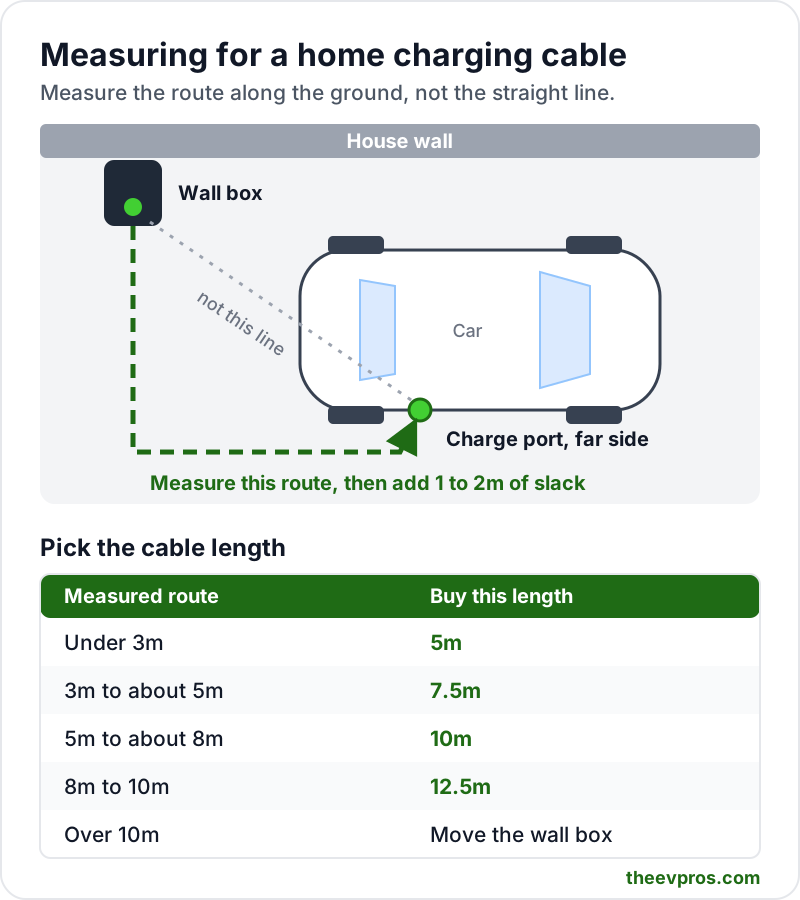
Under 3m of route needs a 5m cable. Up to about 5m, buy 7.5m. Up to about 8m, buy 10m, and from 8m to 10m, 12.5m. Longer runs are possible (Wottz build Type 2 cables up to 50m and Type 1 to Type 2 up to 10m, priced by length on our long charging cables page), but every metre adds weight and bulk. If your run is over 10m, it is usually cheaper and neater to move the wall box or fit a tethered one.
Check where the charge port is before you measure. It can be on the front wing, the rear wing or in the nose, and on the same model it can move between years.
If the cable has to cross a pavement to reach the car, ask your council first. Many do not allow it at all, and the ones that do expect a proper cable cover or channel so nobody trips.
How much does an EV charging cable cost?
A 5m Type 2 to Type 2 cable costs £112.85 in our shop for the 7.4kW version and £136.61 for 22kW. These are the October 2026 prices, including VAT, for cables built to order in the UK by Wottz, plus £9.90 delivery.
| Cable | 5m | 7.5m | 10m |
|---|---|---|---|
| Type 2 to Type 2, 7.4kW | £112.85 | £135.13 | £157.40 |
| Type 2 to Type 2, 22kW | £136.61 | £161.37 | £186.11 |
| Type 1 to Type 2, 7.4kW | £122.76 | £142.55 | £162.35 |
The 22kW cable costs about £24 more at 5m. That is money well spent if your car charges at 11kW or 22kW on AC and you use public posts, and wasted if it does not (see Step 3). Each extra 2.5m adds roughly £20 to £25.
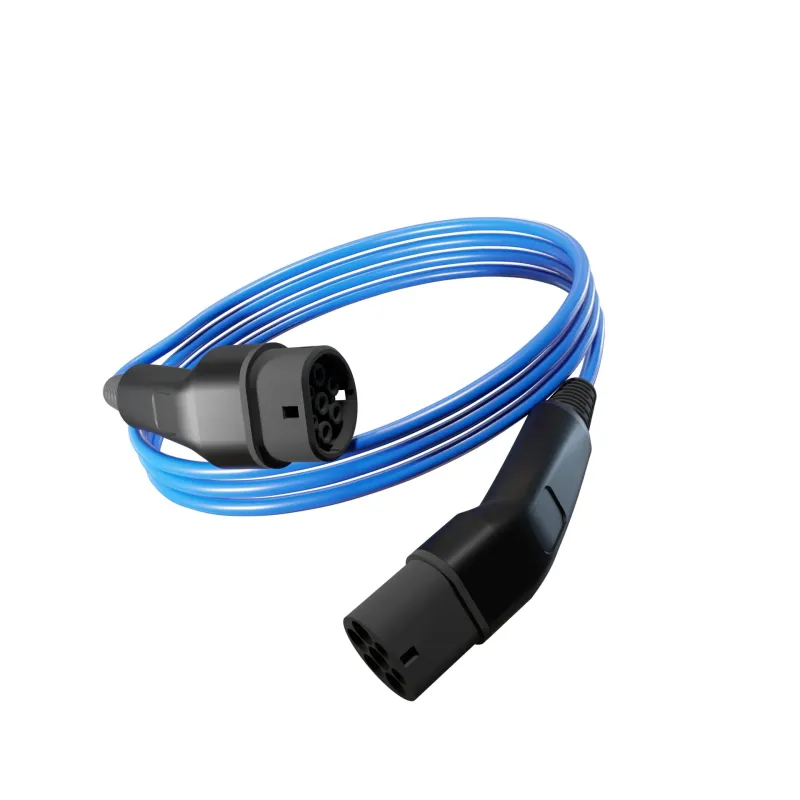
See every length and colour in our Type 2 charging cable and Type 1 to Type 2 cable listings, and every price from 7.5m to 50m on our long charging cables page.
Tethered vs untethered: do you need a cable at all?
A tethered charger has its cable fixed on. A home wall box can be either, and every rapid DC charger is tethered. You never need your own cable for those.
An untethered charger has a socket and no cable. Most public 7kW and 22kW AC posts are untethered, and so are many home wall boxes. That is where your own Type 2 cable comes in.
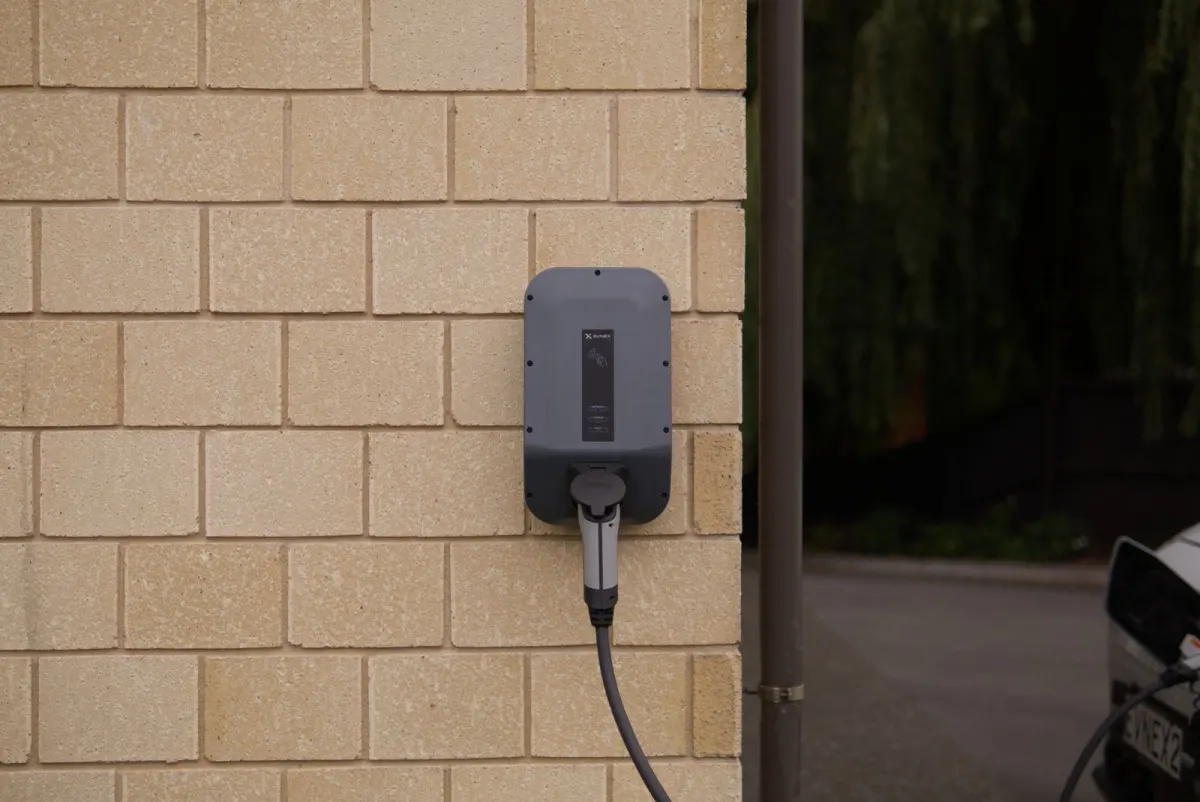
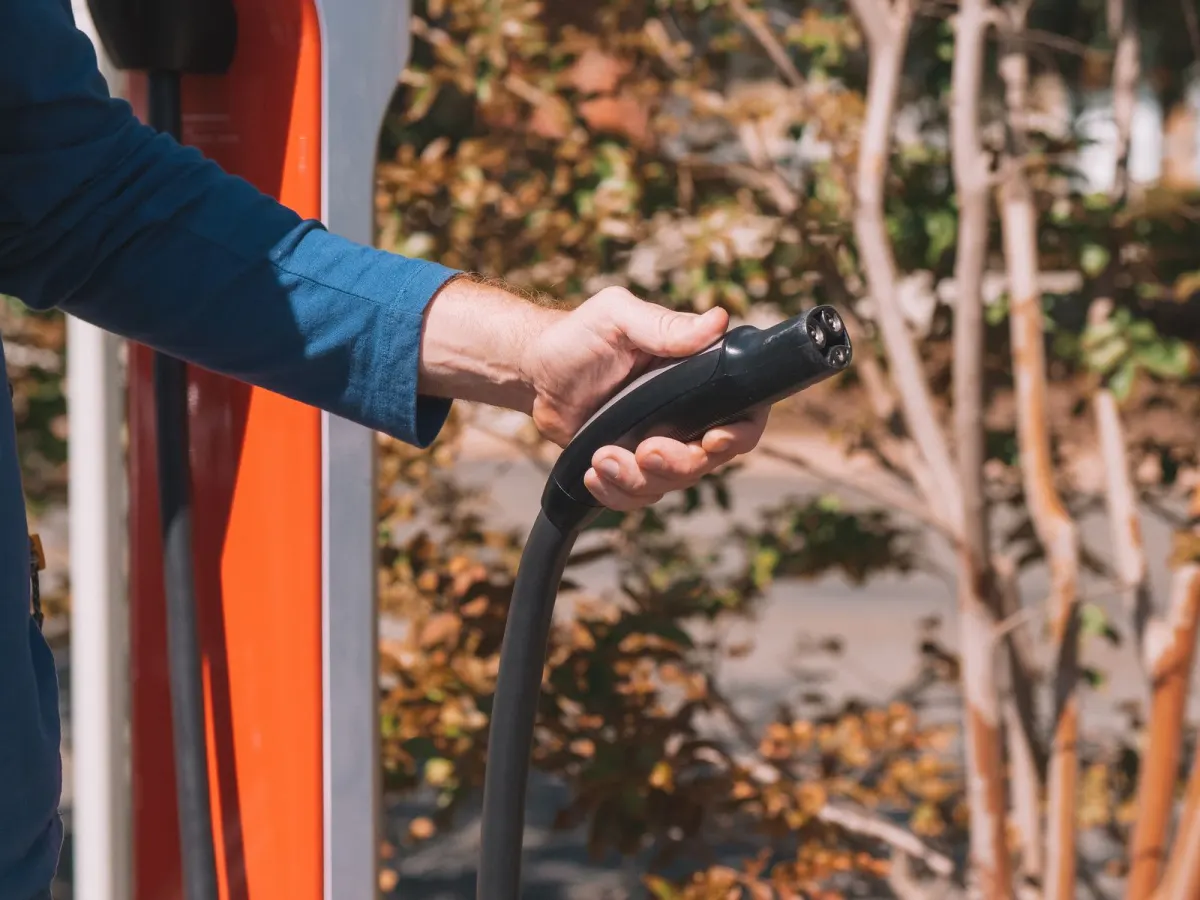
So even if your home wall box is tethered, it is worth keeping a Type 2 cable in the car for public AC posts. Many new cars come with one. Many used cars arrive without it.
Granny chargers: charging from a normal socket
A granny charger, properly a Mode 2 portable charger, plugs into a household 3-pin socket and has a control box in the lead. It is slow: about 2.3kW, so roughly 7 to 9 miles of range an hour. Fine for a plug-in hybrid, a top up overnight or a backup in the boot. Not a replacement for a wall box if you drive any distance every day.
- Plug it straight into a wall socket. Never use an extension lead or a cable reel, which are not built to carry that current for hours.
- If the house wiring is old, have an electrician check the socket before you rely on it every night.
- A commando (32A) version charges at up to 7kW where a commando socket is already fitted, which makes it useful in a workshop, a yard or a holiday let.
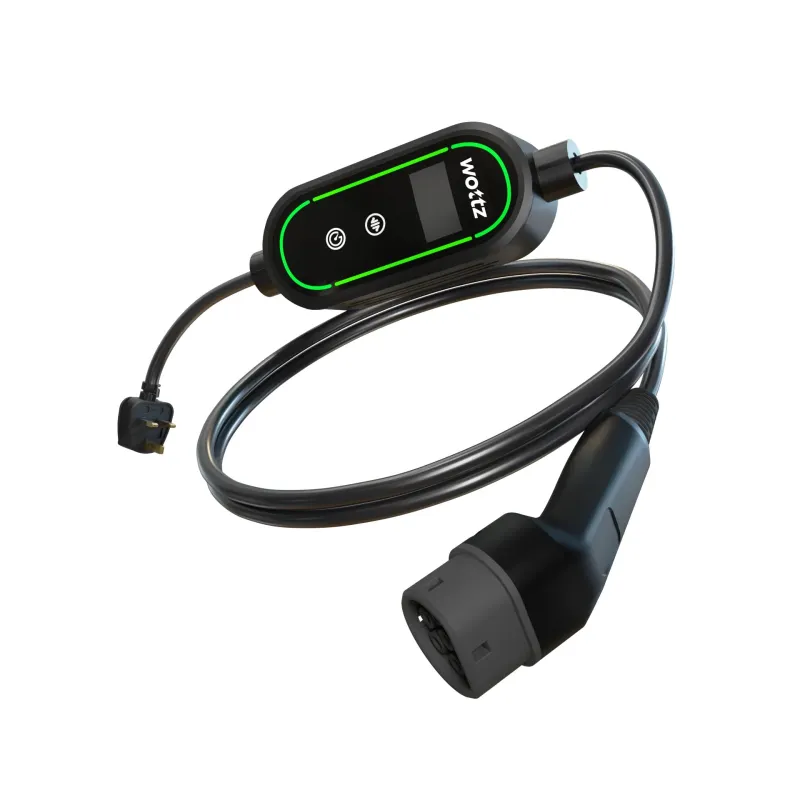
More on speed and safe use in our granny charger guide. Our portable EV charger comes with a Type 2 or Type 1 car connector and a UK 3-pin, Schuko or commando plug, with plug temperature monitoring built in.
V2L cables: powering things from the car
Some EVs can send power out through the charge port. A V2L (vehicle to load) cable plugs into it and gives you a normal socket on the other end, for tools, a kettle, lights or camping kit, at up to about 3.6kW depending on the car.
The car end is specific to the brand, so pick the version for your car. Not every model from a V2L brand supports it, and some manufacturers have switched it off on later cars, so check your car has a discharge or V2L option in its menu before you order.
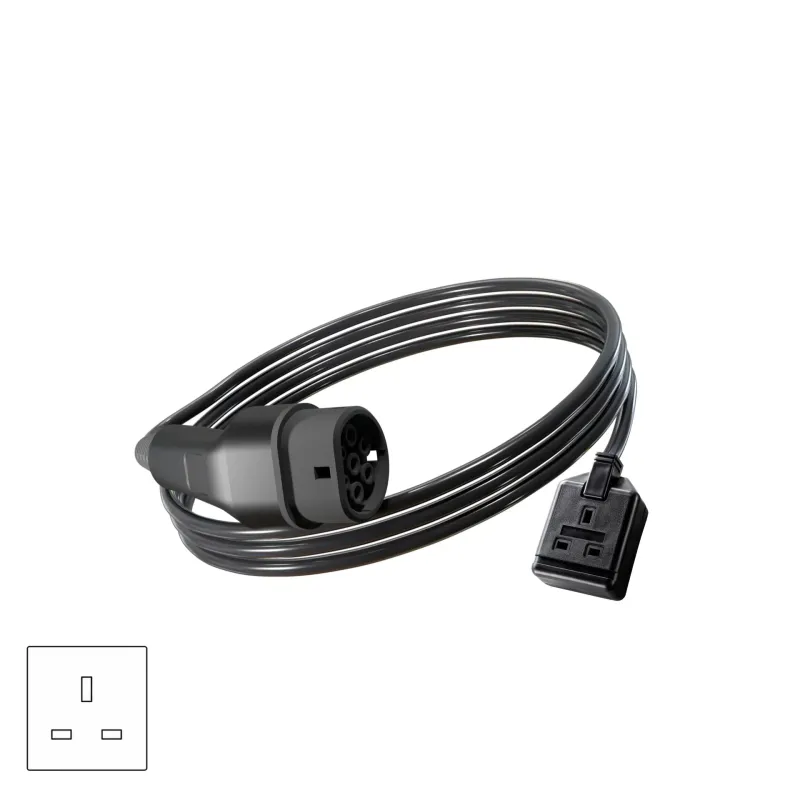
Never connect a V2L cable to a house or any fixed wiring. It is for plugging appliances in, nothing else. See which cars have V2L before you order. Our V2L adapter covers MG, Hyundai, Kia, Genesis, BYD, Renault, Dacia, Smart and more.
Adaptors: a backup, not an everyday fix
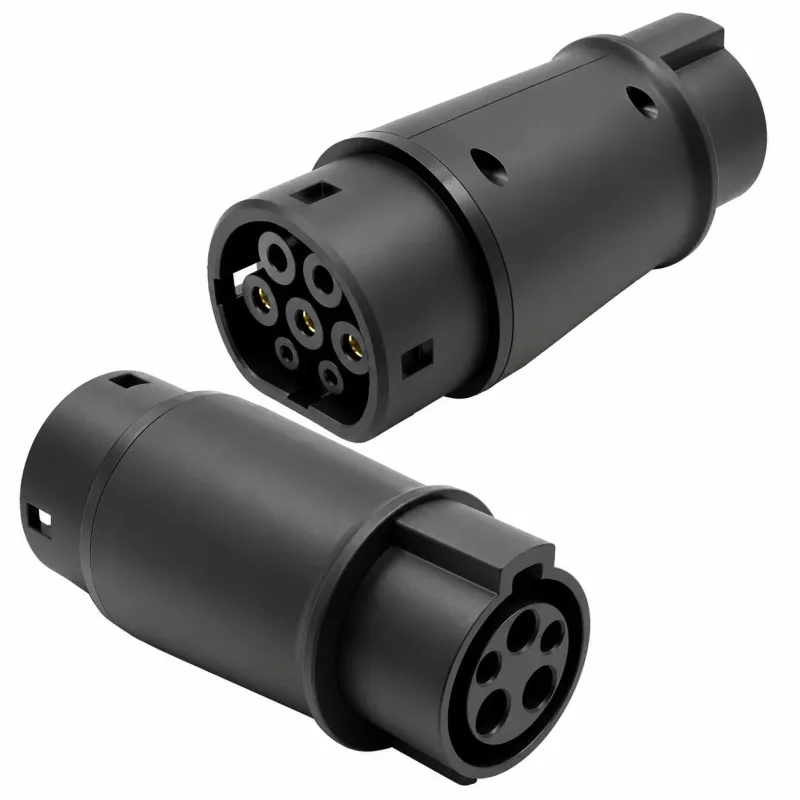
A short Type 1 to Type 2 adaptor lets a Type 1 car use a Type 2 cable, up to 7kW. It is handy as a spare, but it does not lock onto the cable, so always stop the charge before you unplug. If you charge a Type 1 car on public posts every week, a proper Type 1 to Type 2 cable is safer and simpler.
Looking after the cable
Most charging cables do not wear out. They get damp in the pins or get driven over.
- Fit the dust caps whenever the cable is unplugged.
- Keep the plugs out of puddles. A typical plug is IP54 when connected, which means splash proof, not waterproof.
- Do not drive over the cable or close the boot on it.
- Uncoil it fully when you charge at high power, so it does not hold heat.
- If a plug is cracked, a pin is scorched or the cable sheath is cut, stop using it.
If the car will not charge on any cable or any post, the cable is probably not the problem. A faulty charge port, onboard charger or charging software needs an EV repair specialist, and our directory lists them by town.
Everything here is in our EV charging cables and chargers collection. Each cable is built to order in Buckinghamshire and tested before it is sent.
Related on The EV Pros
- Find an EV repair specialist near you →
- Browse all UK locations →
- Cable finder: answer three questions, get the right cable →
- How long does it take to charge an electric car? →
- How much does it cost to charge an electric car? →
- New EV driver guide: your first month →
- Questions to ask before you buy an EV →